
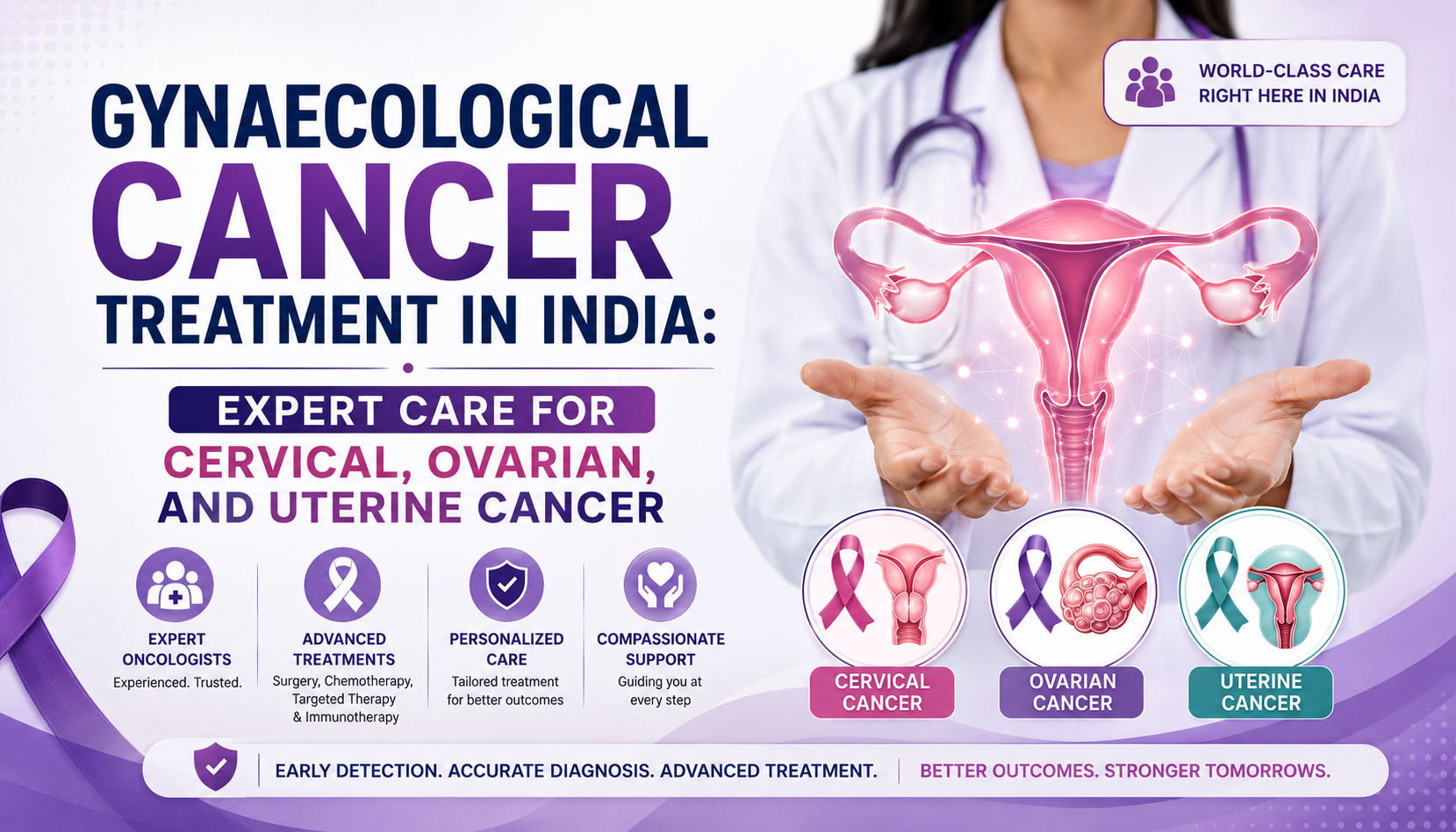
Cancers affecting the female reproductive system - cervical cancer, ovarian cancer, uterine (endometrial) cancer, and less commonly vulvar and vaginal cancers - collectively affect millions of women globally each year. In many low- and middle-income countries, late-stage diagnosis and limited access to specialist oncology care mean that outcomes remain far worse than they need to be.
India's gynaecological oncology programmes offer a path to genuinely expert care, with multidisciplinary tumour boards, subspecialty-trained surgeons, and access to the latest systemic therapies - at costs that make treatment accessible to women who have historically had nowhere to turn.
DivinHeal partners with India's leading gynaecological oncology centres to ensure that every woman facing these diagnoses has access to the care she needs.
Cervical Cancer
Cervical cancer remains the fourth most common cancer in women globally, with the highest burden in sub-Saharan Africa, South and Southeast Asia, and Latin America. It is caused by persistent infection with high-risk strains of Human Papillomavirus (HPV).
Early-stage cervical cancer (Stage I-IIA) is treated primarily with surgery - radical hysterectomy with pelvic lymph node dissection, increasingly performed using minimally invasive and robotic approaches. For locally advanced disease (Stage IIB-IVA), concurrent cisplatin-based chemotherapy and radiation (chemoradiation) is the standard treatment, offering high rates of disease control.
India's gynaecological oncologists are highly experienced in both modalities, and brachytherapy (internal radiation delivered directly to the cervix) - a critical component of cervical cancer treatment that requires specialist expertise - is available at leading Indian centres.
Ovarian Cancer
Ovarian cancer is often diagnosed at an advanced stage because early disease produces few symptoms. Treatment requires a combination of surgery and chemotherapy.
Primary debulking surgery - the goal of which is to remove all visible tumour (complete cytoreduction) - is performed by specialised gynaecological oncological surgeons. The extent of disease removed at surgery is one of the strongest predictors of outcome. India's subspecialty surgeons are trained in the aggressive, extensive surgery required to achieve optimal debulking.
Following surgery, platinum-based chemotherapy (carboplatin and paclitaxel) is standard, with the addition of bevacizumab for high-risk disease. For patients with BRCA1/2 mutations, PARP inhibitor maintenance therapy (olaparib, niraparib) significantly prolongs progression-free survival - and is available in India at substantially lower cost than in the West.
Uterine (Endometrial) Cancer
Endometrial cancer is the most common gynaecological cancer in high-income countries, often presenting with postmenopausal bleeding at an early, curable stage. Treatment is primarily surgical - hysterectomy with bilateral salpingo-oophorectomy and lymph node assessment.
Minimally invasive (laparoscopic or robotic) hysterectomy for endometrial cancer is the standard at India's leading centres, offering equivalent oncological outcomes to open surgery with significantly faster recovery. For high-risk disease, adjuvant radiation and/or chemotherapy is added.
DivinHeal's Gynaecological Oncology Coordination
DivinHeal begins with a full review of pathology, staging imaging, and molecular testing results. The medical team identifies the most appropriate gynaecological oncologist - matching subspecialty expertise to disease type and stage. Consultations can be arranged via telemedicine before travel, and the full treatment pathway is planned in advance to minimise time between arrival in India and the start of treatment.
FAQs
Q1. Is treatment for advanced gynaecological cancer available in India?
Yes. India's gynaecological oncology centres manage all stages of cervical, ovarian, and uterine cancer, including advanced and recurrent disease. HIPEC (Hyperthermic Intraperitoneal Chemotherapy) for advanced ovarian cancer and exenterative surgery for recurrent cervical cancer are performed at select centres within DivinHeal's network.
Q2. How quickly can treatment start after arriving in India?
DivinHeal pre-arranges consultations so that evaluation begins within 1-2 days of arrival. For patients who have already had staging workup and biopsy results, treatment can often begin within the first week of arrival.
Q3. Can fertility be preserved during gynaecological cancer treatment?
For young women with early-stage cervical or endometrial cancer who wish to preserve fertility, conservative surgical options - including radical trachelectomy (removing the cervix while preserving the uterus) for cervical cancer and hormonal treatment for carefully selected early endometrial cancer - are available. DivinHeal's specialists discuss these options thoroughly with eligible patients.
Q4. What is the cost of ovarian cancer treatment in India compared to the US?
Debulking surgery for ovarian cancer in the US: $50,000-$100,000. In India with DivinHeal: $6,000-$10,000. A full course of carboplatin-paclitaxel chemotherapy in the US: $50,000-$80,000. In India: $5,000-$10,000. PARP inhibitor maintenance therapy: $10,000-$15,000 per month in the US versus $1,000-$3,000 per month in India.
Q5. Does DivinHeal offer support for women travelling alone for treatment?
Absolutely. Many of DivinHeal's patients travel without a companion, and the care coordination team provides dedicated support - including airport reception, accompaniment to hospital appointments, and daily check-ins throughout the treatment period. No patient is left to navigate the system alone.
Also Read: Stem Cell Therapy in India